
“Within bamboo, there exists both strength and silence.
Through weaving, space itself becomes part of the form.”
In the art of bamboo craftsmanship, woven bamboo vessels can already be found as early as the Jōmon period. In addition to works preserved in the Shōsōin repository, there are also examples such as kego baskets from the Heian period. From the Muromachi period onward, bamboo works came to be used in the practice of the tea ceremony, leading to the creation of a wide variety of objects including tea scoops, flower containers, flower baskets, daisu stands, and portable baskets.
While retaining a distinctly Japanese character, these techniques continued to evolve in many technical and artistic directions, and have been passed down into the present day. Broadly speaking, bamboo craftsmanship may be categorized into woven works, round bamboo constructions, flat bamboo constructions, and tea scoops.
Materials commonly used include madake bamboo, black bamboo, moso bamboo, hachiku bamboo, nemagari-dake, and smoked bamboo. Finishes may preserve the natural appearance of the material, incorporate dyeing techniques, or be completed with wiped lacquer.
Woven Bamboo Works
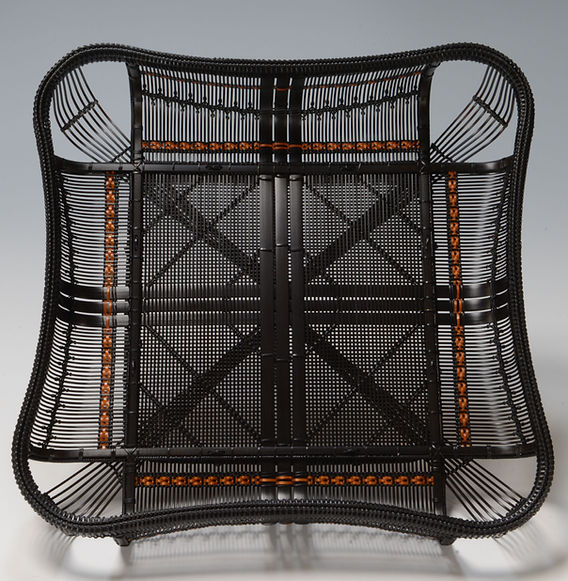
Woven works form the heart of bamboo craftsmanship. Fully dried bamboo is first stripped of its natural oils, the outer surface carefully shaved, and then finely split into narrow strips. The width and thickness of each strip are adjusted according to the individual work being created. Through processes such as base weaving, raising the sides, body weaving, and edge finishing, the piece gradually takes shape as a three-dimensional form.
When dyeing is applied, there are two approaches: saki-zome (pre-dyeing), in which the materials are dyed beforehand, and ato-zome (post-dyeing), in which the finished work itself is dyed. Pre-dyeing allows multiple colors to be incorporated within a single piece, while post-dyeing produces a unified tone throughout the work.

Bamboo Constructions
In works made with round or flat bamboo constructions, individual sections are created separately and later assembled together. This technique lends itself particularly well to the creation of free and expressive forms.
The lines and woven patterns created through bamboo weaving and construction possess a delicate elegance and refined beauty. There exists a great variety of techniques, many of which developed uniquely in different regions of Japan, each with its own terminology and traditions.
In this way, bamboo works are created through the combination of numerous techniques, and it is precisely this synthesis that becomes an expression of each artist’s individuality.